What is Natural Flood Management?
What is Natural Flood Management?
Natural flood management (NFM) refers to the use of natural processes to reduce the risk of flooding. It involves restoring or mimicking the natural hydrological processes that occur across the landscape, processes that have typically been altered from historic farming practices and industrialisation. These include slowing the flow of water, storing water, holding back the sediment, and aiding water infiltration into the soil to prevent large volumes of runoff. NFM measures aren’t designed to replace traditional engineering methods e.g., floodwalls, embankments, storage reservoirs, but instead they will be an important part of the mosaic of lentic waterbodies, all working together to reduce the risk of flooding.
Importantly, the philosophy of NFM is to always work with nature.
This is done by a simple three step approach as follows:
- Protect nature – survey the landscape for things that are already functioning well to reduce flooding. For example, is there a fallen tree across a water course that is acting as a leaky woody dam already? Maintaining and protecting what is working well is always the first step.
- Restore nature – understand the source of the problem and aim to restore the natural hydrological processes. For example, is there a watercourse that has been straightened out increasing the velocity of the flow and causing flooding downstream? If so, adding in the meanders and reconnecting the river to its original flood plain will help to restore its natural flow. This stage also involves soil and land management interventions that may help to tackle the problem.
- Mimic nature – sometimes changing the landscape to restore the natural hydrological processes isn’t always an option. Here, NFM interventions could be added to mimic these natural processes. For example, scrapes in the landscape could be added to store overland runoff, mimicking the slower runoff pattern that would be expected in natural settings.
Types of natural flood management in a river catchment
Floodplain reconnection
This measure aims to restore or enhance the natural function of the floodplain to help store the water. It involves measures such as lowering, removing, or setting back existing embankments, installing features in the channel to push the flow into the floodplain, restoring any wetland on the existing floodplain, and reconnecting any remnant channels.
Leaky barriers
The aim of leaky barriers (otherwise known as leaky dams) is to slow down the flow of the water during high flows and store it in small streams and their immediate flood plains. The design of the leaky dam should always take advantage of local materials, whether that be finding large logs or using local stone.
River channel restoration
The aim of this is to restore previously modified river channels that have been artificially changed. For example, re-meandering straightened channels.
Runoff storage
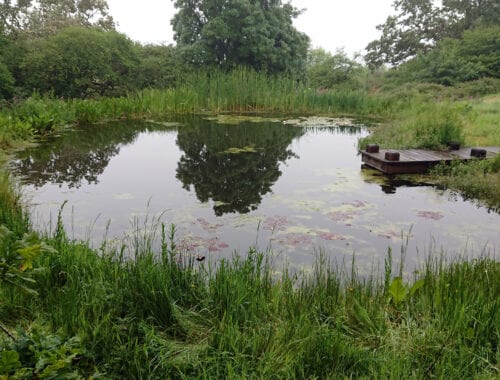
The aim of this measure is to store water on land to reduce the amount reaching the watercourse and encourage infiltration. This can be done through the creation of ponds, scrapes, bunds, and swales.
Offline storage
This is when water is diverted away from an overland flow pathway or stream to be temporarily stored close by.
Other NFM measurements
Other NFM measures include upland and peatland management, soil and land management, cross slope woodland, riparian woodland, floodplain woodland, and catchment woodland.
Figure 1 shows a NFM hierarchy which could be taken as a general guide in certain instances. This hierarchy is based on first focusing on restoring natural measures before moving on to other ways of storing and reducing the flow of water.

Figure 1. The NFM Hierarchy. Source: Natural Flood Management Guidance for Devon. Version 1.2 (April 2021)
Natural flood management considerations
To hold or slow down the necessary target volume of water in a catchment, multiple NFM interventions are usually required to work alongside each other rather than employed individually. The NERC Natural Flood Management Research Programme found that NFM can provide quantifiable flood-risk benefits and associated economic benefits at intermediate catchment scales up to approximately 50 km2.
They found that to achieve maximum benefit from NFM, the techniques need to be designed to be engaged at high flow, monitoring the installed features is necessary to find out where improvements can be made, landowners and farmers need to be engaged to deliver the required level of interventions for catchment protection, and the benefits of multiple interventions can usually be stacked depending on the context.
The type of measure chosen is based on multiple factors such as the catchment setting, soil types, environmental designations, and available funding.
What are the other benefits of NFM?
In addition to reducing the risk of flooding, NFM has a large variety of other benefits.
- Restores habitats for wildlife, boosting biodiversity.
Creating habitats such as wetlands improves biodiversity and encourages connectivity so species can move between habitats.
- Improves soil health.
NFM helps to retain the soil on land rather than it being eroded and washed into the watercourses. This has benefits to the river ecosystem through the preventing siltation on fish spawning beds and keeping pollution away from the watercourse.
- Improves water quality.
NFM can improve the chemical and ecological status of a water body by managing the sediment, nutrient input, and pollution. For example, reconnected floodplains and swales allow organic sediment, fertilisers, and pesticides to accumulate and settle out of the flow.
- Engages the community and promotes health and wellbeing.
Access to nature improves mental and physical wellbeing. Measures can also enhance educational opportunities for local community groups.
- Increases resilience to climate change.
Wetland habitats such as ponds and scrapes, floodplains, and woodland creation all capture and store carbon, helping to mitigate against climate change. NFM measures also increase the health of the soil, and healthy soil has better water retention, thus reducing the impacts of drought and making the landscape more resilient to climate change. If NFM measures are carried out in urban landscapes they have additional benefits of urban cooling, reducing the urban heat island effect, and increasing climate resilience.
Why is NFM important?
The frequency and intensity of flood events are increasing in the UK due to climate change. Devon is a county that is prone to high-intensity storms and floods already, ranging from small, localised flood events to countywide storms. Additionally, the UK has lost almost half of its biodiversity since the 1970s. As the impacts of extreme weather conditions are on the rise, NFM techniques are becoming increasingly important as they address biodiversity loss and mitigate against climate change.
How can Lost Habitat help?
We regularly work with Delivery Partners including Devon Wildlife Trust, North Devon Biosphere and the Environment Agency collaborating partnerships with landowners to secure funding towards NFM projects.
We are able to create resilient ecosystems and improve biodiversity supporting the natural environment with sustainable nature-based solutions for flood mitigation, water retainment, soil erosion and carbon sequestration, with the purpose to reconnect watercourses back to their original floodplain and to restore degraded wetland habitat.
For further information connect with us.

Upstream Thinking Programme
You May Also Like

The Importance of Trees

What is Ecological Landscaping?